Lawns and turf
How much turf do I need? Measuring awkward Tyneside gardens
Ordering turf is easy when the garden is a neat rectangle. Most are not. Here is how to measure L-shapes, curves and slopes, and how much extra to add so you are not a few rolls short on the day.
By the Gardens North East teamPublished , 4 min read
What you need
A long tape measure (a 30 m surveyor's tape is easier than a steel rule), a notebook, a pencil and ideally someone to hold the other end. Draw a rough plan of the area first, then write measurements on it as you go. Measure in metres to one decimal place; turf is sold by area, so square metres are what you are working towards.
Measure only the area that will be turfed. Leave out paths, beds, the shed base and any border you plan to keep, and decide now whether you want a strip of soil between the lawn and a fence. It makes mowing easier and saves a few rolls.
Split the shape into simple pieces
Almost any garden can be broken down into rectangles, triangles and circles. Work out each piece and add them together.
Rectangles and squares
Length multiplied by width. A lawn 6.2 m long and 4.5 m wide is 27.9 m².
L-shaped yards
Common behind terraces where the back extension takes a bite out of one corner. Split the L into two rectangles with one imaginary line, measure each, then add. For example, 7 m × 3.5 m (24.5 m²) plus 3 m × 2.4 m (7.2 m²) gives 31.7 m².
Triangles
Half the base multiplied by the height, measured at right angles to the base. Corner plots on new estates often end in a triangle.
Circles and curves
For a circle, measure the radius (centre to edge) and multiply it by itself and then by 3.14. A circular lawn with a 2.5 m radius is about 19.6 m². For a gently curved edge, measure the area as if the edge were straight, then add a little extra for the bulge.
Truly irregular gardens
For a shape that defies rectangles, run a straight line along the longest side and measure out from it to the edge of the lawn at regular steps, say every metre. Average those widths and multiply by the length of the line. It sounds fiddly but takes ten minutes and is far more accurate than guessing.
Another approach is to mark a rough grid of one-metre squares with canes and string, count the full squares and add half for every square that is partly lawn.
Slopes
On a sloping garden, measure along the surface of the ground, not the flat distance across the top as a plan would show it. Turf has to cover the slope itself, which is longer than the level distance. On a steep bank the difference can be enough to leave you short.
Steep banks are also harder to lay on. Rolls can be pegged in place while they root, and laying across the slope rather than up and down it helps them stay put.
How much extra to allow
Every cut around a curve, path or border wastes a little turf. As a rule of thumb:
| Garden shape | Extra to add |
|---|---|
| Simple rectangle with straight edges | About 5% |
| Some curves, a path or a few beds | About 5 to 10% |
| Lots of curves, island beds or narrow strips | About 10% |
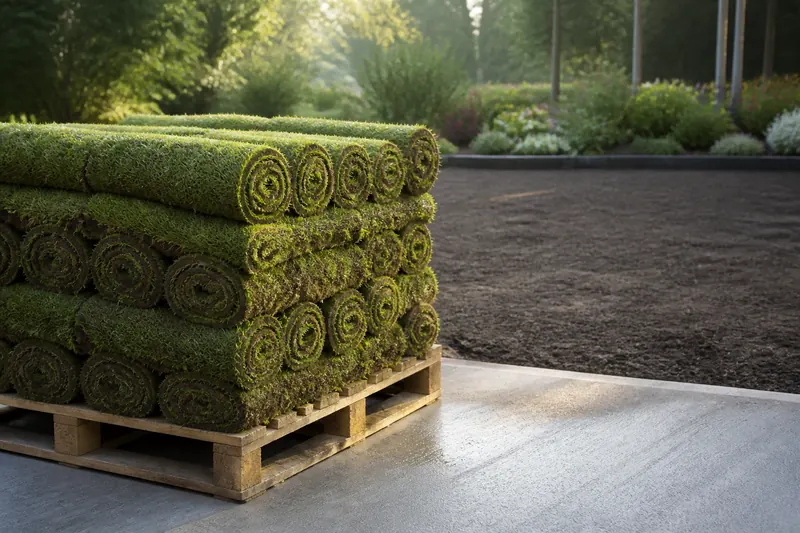
Round up to the next whole roll. Most suppliers sell turf in rolls of about one square metre, but check the size your supplier uses before you divide.
Before you order
Check how the turf will reach the garden. Terraces with back lanes, gardens up steps and homes where every roll has to come through the house all affect where a delivery can be left and how long carrying will take. Turf is heavy, especially when wet, so clear a route and have a wheelbarrow ready.
Shade matters too. If a large tree darkens part of the lawn, grass there will always struggle. A qualified tree surgeon can advise on whether crown lifting or thinning would let more light through; some are listed below. Read when to lay turf to pick your month, and the turfing cost guide for what affects the price.
Once you have your number of rolls, Buy Turf Newcastle shows the full delivered price for your postcode before you pay. If the measuring has convinced you to hand the job over, Turf Laying Newcastle will measure and quote for laying it.
Questions readers ask
Should I measure in feet or metres?
Metres. Turf is sold by the square metre, so measuring in metres saves a conversion step and the mistakes that come with it.
What if I order too little?
A second delivery can be arranged, but the new rolls may look slightly different until they settle, and you pay for delivery twice. A small allowance for waste avoids it.
Do I measure the area before or after edging the beds?
After you have decided where the beds will be. Mark the edges with a hose or string first, then measure the lawn that is left.
Got your number?
With an area in square metres, you can price turf straight away. For gardens in Newcastle upon Tyne, this supplier shows the full delivered price on screen before you pay.
Turf sold by the roll for Newcastle gardens, with the full delivered price on screen before you pay.
Old lawns lifted, ground prepared and new turf laid, with a free quote.
Some listings may be sponsored. How we list businesses
Local help
-
Arbor Division Ltd
-
The Tree Fella NE Ltd
-
Northumberland Wildlife Trust